

 Pacific
 Pacific
National Workshop “Advancing Maritime Decarbonisation and Technology Uptake in Tonga”
Type of Activity: National Workshop
When: 28-29 September 2026
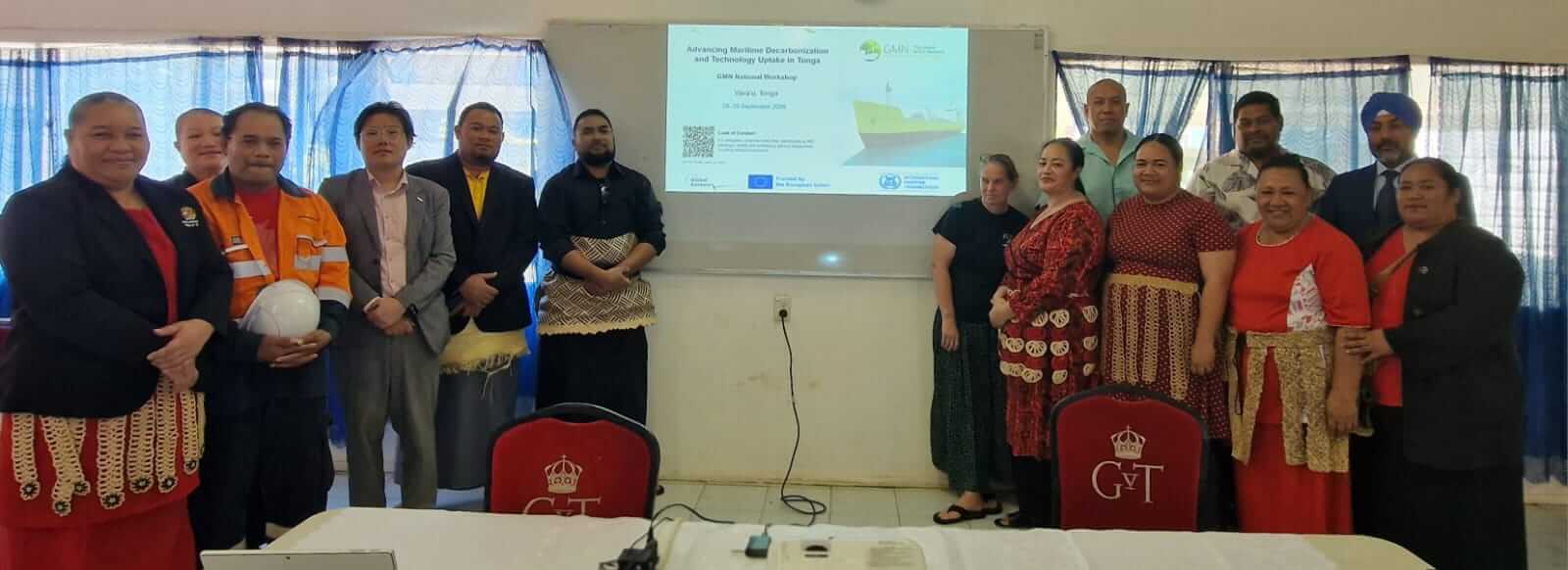
The GMN Phase II Project successfully held the National Workshop on “Advancing Maritime Decarbonisation and Technology Uptake in Tonga” at the Governor’s Office in Neiafu, Vava’u, on 28-29 September 2026. The GMN Phase II Project is implemented by the International Maritime Organization (IMO) and funded by the European Union (EU).
The workshop brought together national stakeholders from institutions working across the maritime, climate, energy and development sectors.
Discussions focused on Tonga’s maritime decarbonisation context; locally appropriate technologies; barriers and enabling conditions for technology uptake; capacity development; climate finance; monitoring, data and ICT systems; stakeholder engagement; gender equality; and sustainable operation and maintenance of new technologies.
Key outcomes included:
-
Identification of existing strengths and enabling conditions, including Tonga’s maritime institutional framework, ongoing maritime and port-safety activities, stakeholder cooperation, green-energy initiatives, progress towards domesticating MARPOL Annex VI, and the inclusion of maritime decarbonisation in Tonga’s nationally determined contribution.
-
Discussion of the proposed GMN II technology pilot at Queen Halaevalu Wharf, which focuses on solar photovoltaic generation and battery energy storage.
-
Exploration of the technical, institutional, financial and capacity-related conditions needed to support the uptake of maritime decarbonisation technologies.
-
Enhanced dialogue on strengthening coordination among relevant ministries, developing the legislative and enforcement framework, improving monitoring and ICT systems, and aligning maritime priorities with national development priorities.
-
Recognition of the importance of targeted training, professional development, scholarships, knowledge retention and maintenance capacity for solar panels and battery storage systems.
-
Discussion of climate-finance opportunities, project-preparation capacity and potential partner support for maritime decarbonisation initiatives.
-
Emphasis on early and sustained community engagement, inclusive consultation, gender equality and sex- and age-disaggregated participation data in the design, implementation and monitoring of technology initiatives.
The workshop also identified possible follow-up actions, including strengthening maritime representation in local development planning, establishing coordination between maritime stakeholders and infrastructure authorities, advancing technical work on the pilot’s grid connection, raising awareness of maritime career pathways among young people, and incorporating post-project operation and maintenance arrangements into project design.
The issues and possible areas for follow-up identified during the workshop will support continued national dialogue and GMN II support, while informing the development of the proposed technology pilot at Queen Halaevalu Wharf.
For further information, please see the Workshop report: Tonga_GMN_II_National_Workshop_Report_Technology_Uptake